basically Sorter
The basically Sorter is an open source LEGO® sorting and kitting machine. It is the first sorting machine that is reproducible and mass-manufacturable.
The Brick Sorting Machine
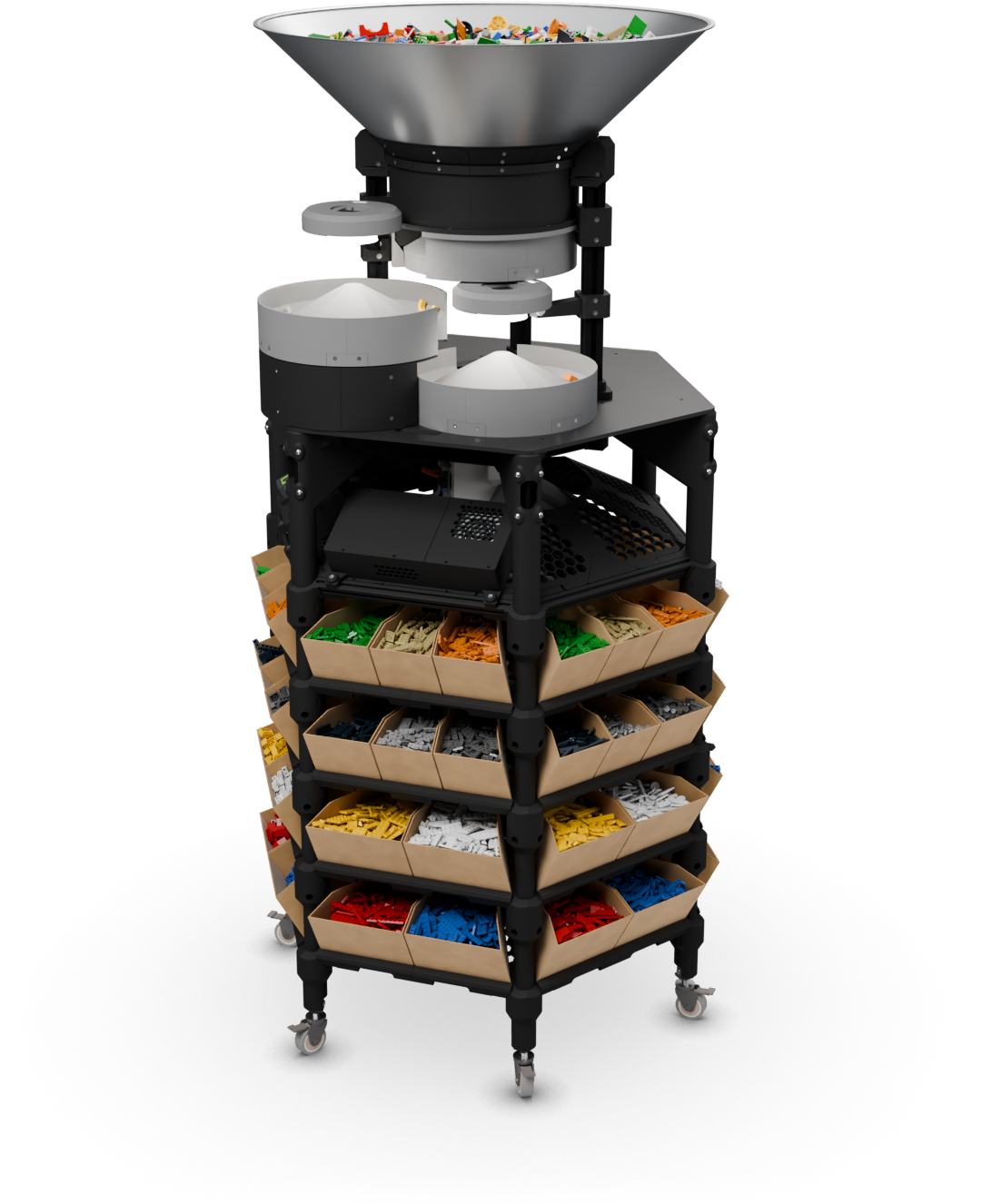
The idea
01 · Swiss
A hard left edge, a strong grid, black type on off-white, generous space. The layout never decorates. It only orders.
02 · The object is the hero
The machine is photographed, or rendered as if photographed, on a white stage. Type stands behind it or beside it, never on top of it.
03 · One accent at a time
Yellow highlights the one line that matters. Cyan is the brand panel. They do not share a surface, and neither is used as a tint, a border, or a link color.
04 · Plain words
Sentence case. Short sentences. Facts before adjectives. The tone of someone who built the thing and would rather show it than sell it.
Type
One family, Sofia Sans, from Cindy’s banner and poster. Display and headings are Black (900) with tight tracking and a line height under 1. Body is Regular at 18 px. Labels are bold, small, and letterspaced uppercase; they are the only uppercase on the page.
Sofia Sans Extra Condensed at 900 is the second register, used for stamped labels and the brick line, as on the card.
Display · 900 · 0.82 · -0.04em
Sorter
H1 · 900 · 0.92 · -0.03em
How does it work?
H2 · 800 · 1.0 · -0.02em
Bulk pieces come in through the top
Lead · 400 · 1.3
It’s also the first sorting machine that is reproducible and mass-manufacturable.
Body · 400 · 18/1.45
Clumps of pieces are broken apart and singulated. They’re classified by exact part and color with Brickognize. According to user-defined rules, pieces are put into a specific box.
Condensed · 900 · uppercase off
the basically brick
Label · 700 · 13 · +0.08em · uppercase
How can it sort?
Color
Six values, sampled from the banner. Paper and ink do almost all the work. The two chromatic colors are loud on purpose and are rationed for it.
Every page. Never pure white.
All type, all rules, all line drawings.
The brand block only: the panel the brick and wordmark sit on.
The highlight, always at full strength. One per view.
Technical drawings and secondary strokes.
Placeholders, disabled, table stripes.
Highlight
One yellow rectangle behind a phrase, padded to the cap height, square corners. If the phrase wraps, it wraps inside the same rectangle. It is how the banner carries its tagline. One yellow, at full strength, and one highlight per view.
On the banner
Automatic LEGO® Sorting Machine
As the tagline
The Brick Sorting Machine
A short token in a sentence
Reservations are refundable. The stated first-run price is $8,000, invoiced when a unit is scheduled.
Never a long run inside a sentence
The highlight is one rectangle, so it cannot flow across a line break. A phrase that stands on its own line, or a token of a word or two, and nothing longer inside running text.
Imagery
Two registers and nothing between them.
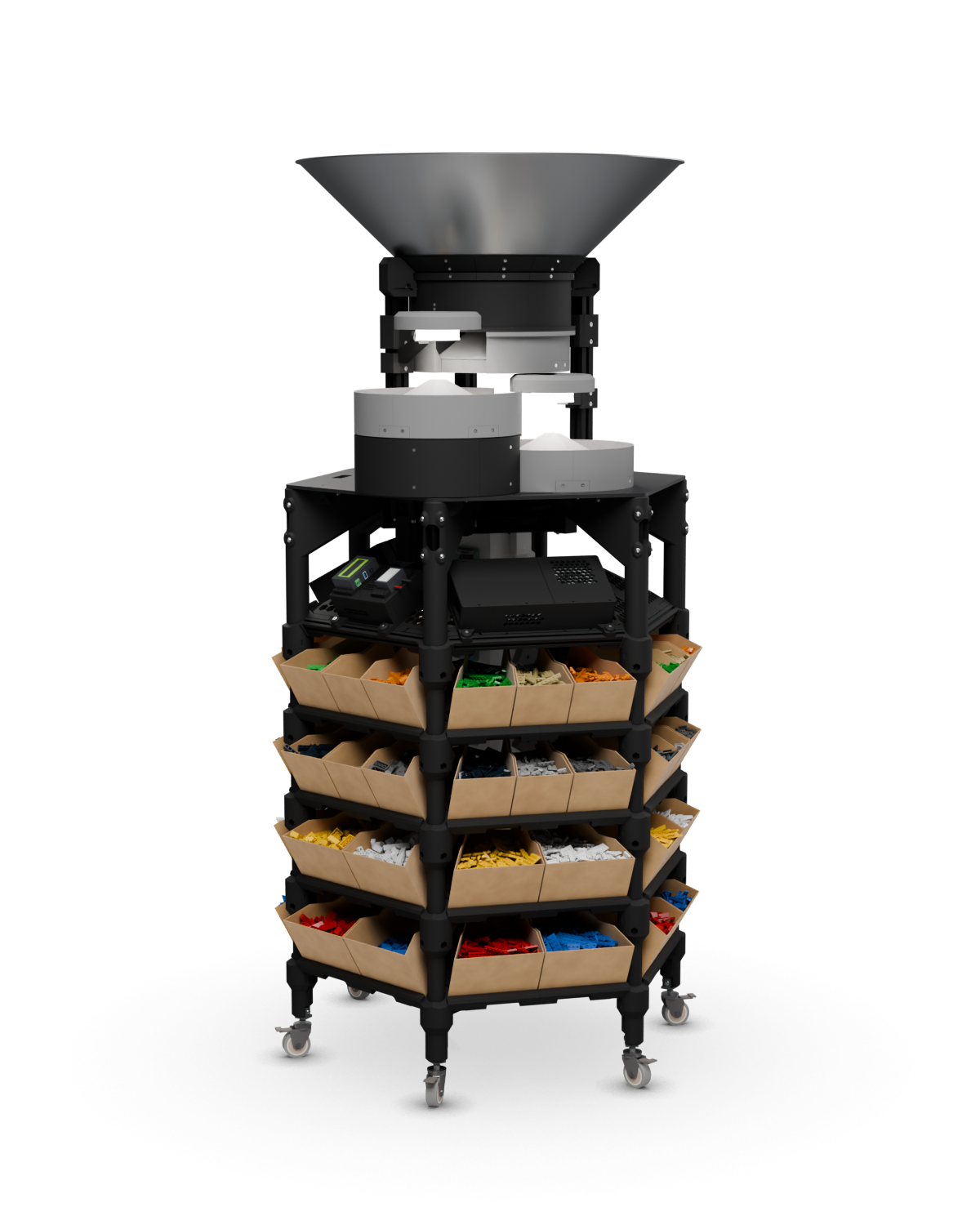
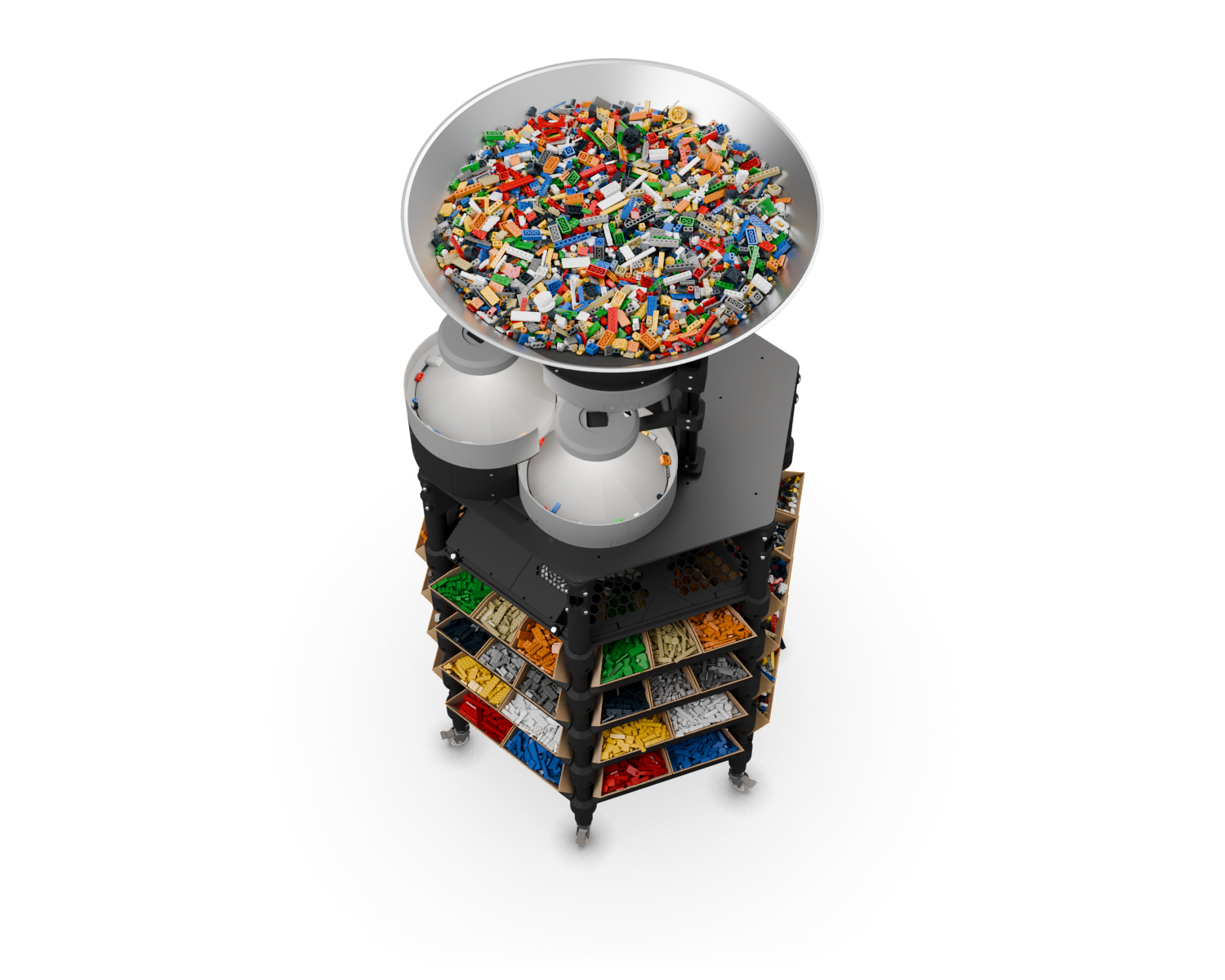
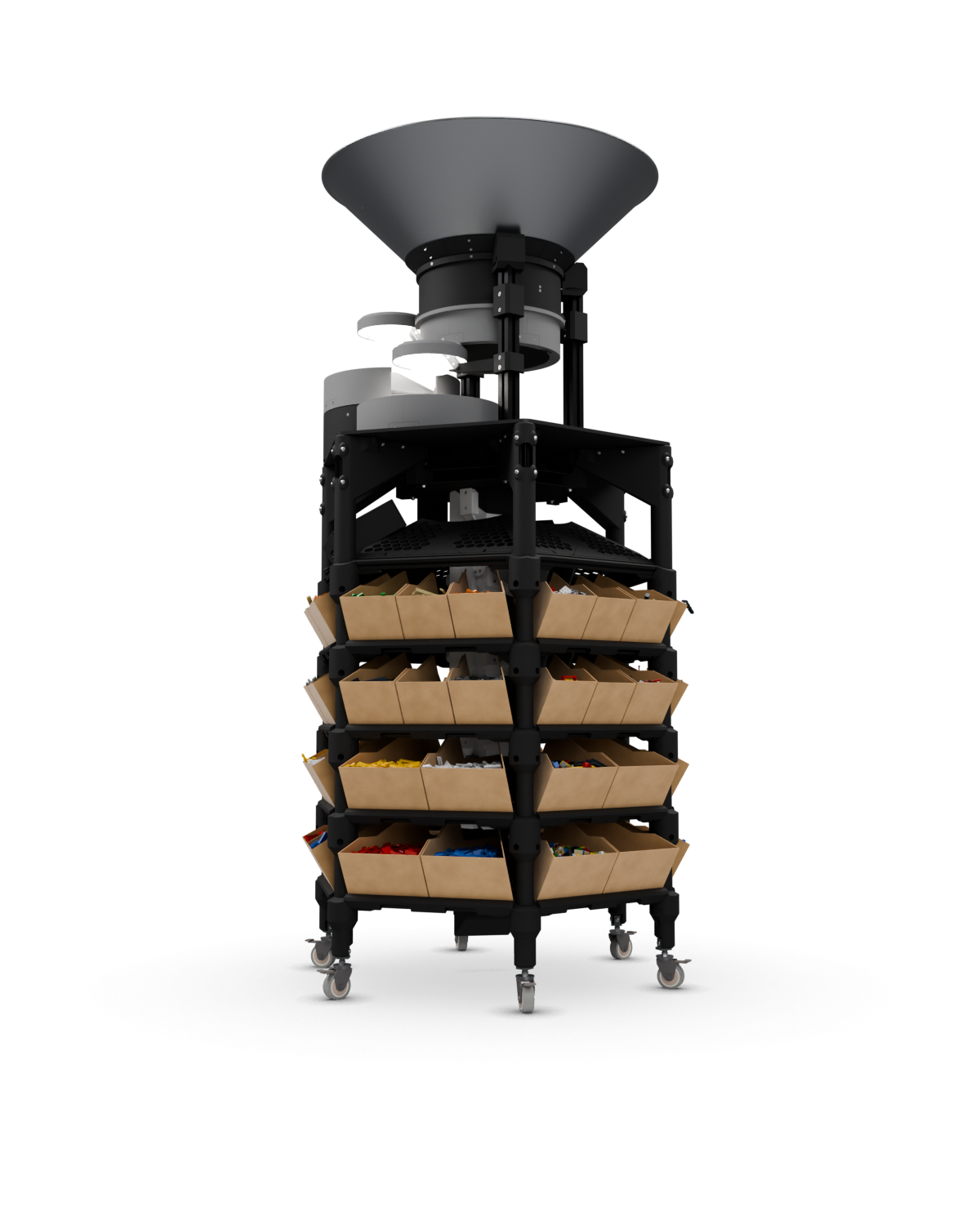
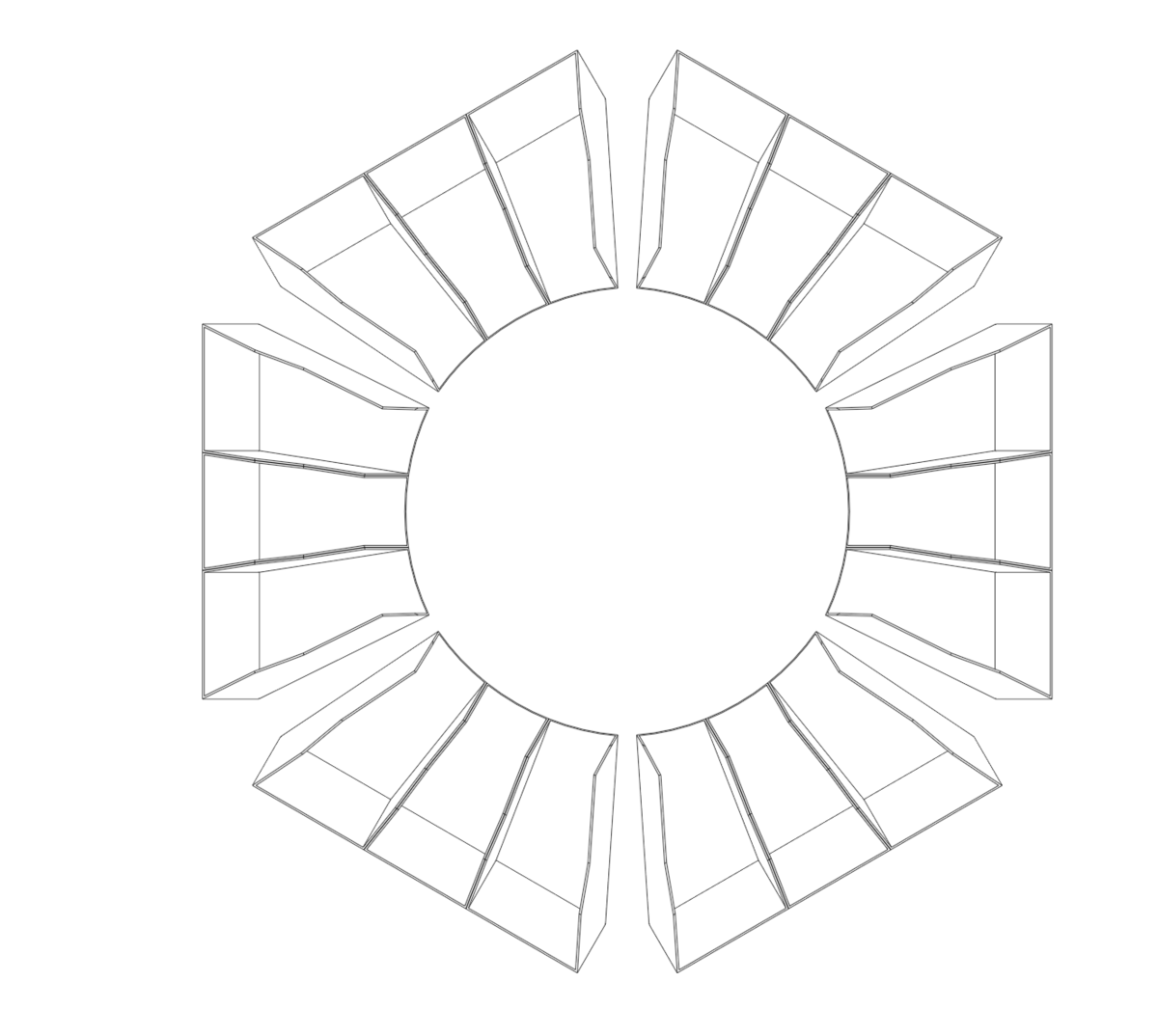
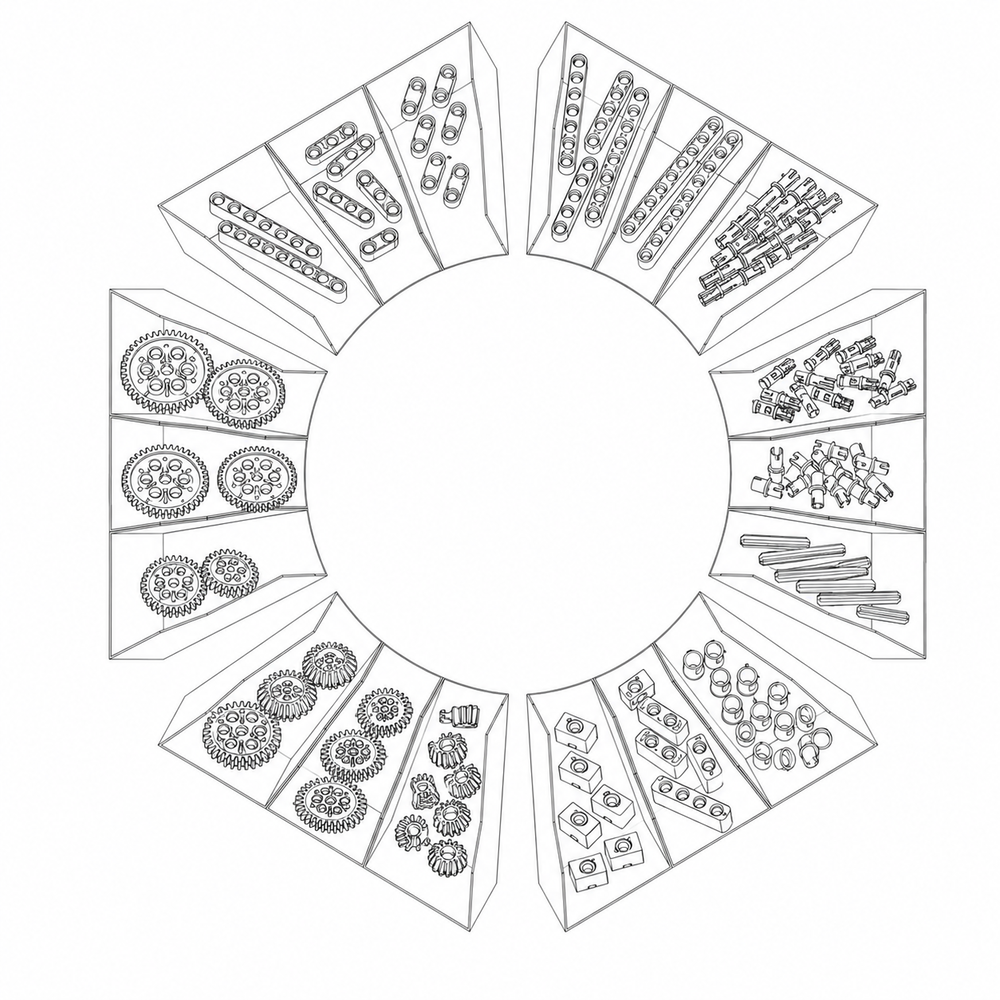
The photo stage. The machine on a white cyc, lit softly, with a small contact shadow and the floor bouncing light back up. Renders are made to match that photo, never the other way round. No drop shadows, no floors, no rooms.
The line drawing. Thin ink lines on paper, the way the bin ring appears on the banner: an engineering view, no shading, no fills. It carries the technical story so the photo stage never has to.
Motion
A turntable is a photo stage that turns. Same light, same floor, one full revolution at a constant speed, no cuts, no easing. Video sits inside the grid like a still: WebM with alpha where the browser can, the copy on white multiplied onto the stage where it cannot.
Components
Square corners everywhere. Every line is 1 px ink: borders, rules between sections, rows in a table. There is no thicker line, and two lines never sit next to each other. Nothing is rounded, gradiented or shadowed, except the stage floor. The one glass on the page is the sticky nav, paper at 90% over a blur, and it is used there and almost nowhere else.
Buttons
Primary is ink on paper. Secondary is outlined. Tertiary is an underlined line of text. There is no yellow button and no cyan button.
Facts
60
bins
4
stages, top to box
1
piece at a time
open
source, all of it
Spec table
| Input | Bulk pieces, through the top |
|---|---|
| Singulation | Clumps broken apart into single pieces |
| Classification | Exact part and color, with Brickognize |
| Output | User-defined rules route each piece to a box |
| Bins | 60, in a ring |
| Source | Open |
Card
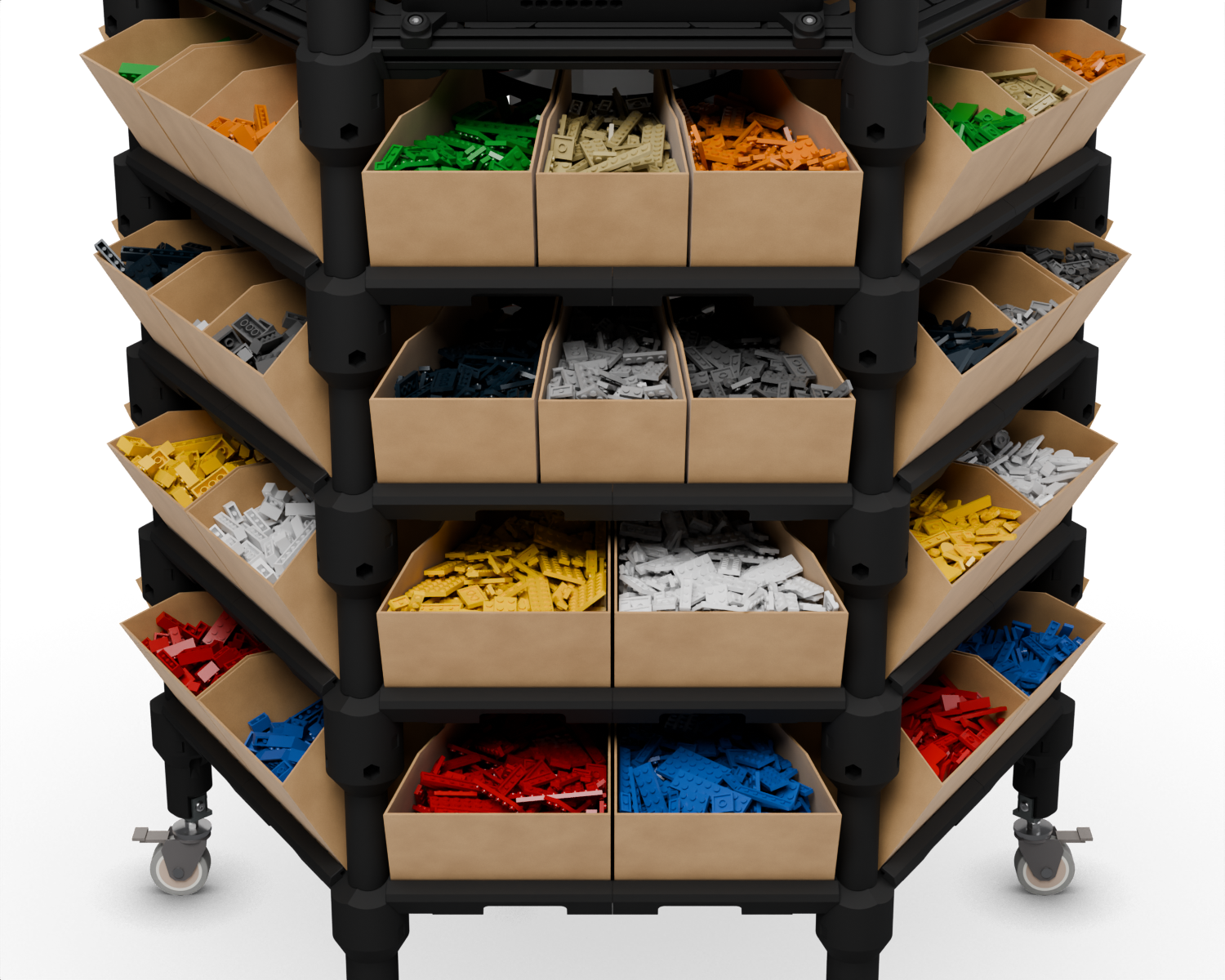
Bins
Sixty boxes
A ring of sixty, each one a destination the rules can name.
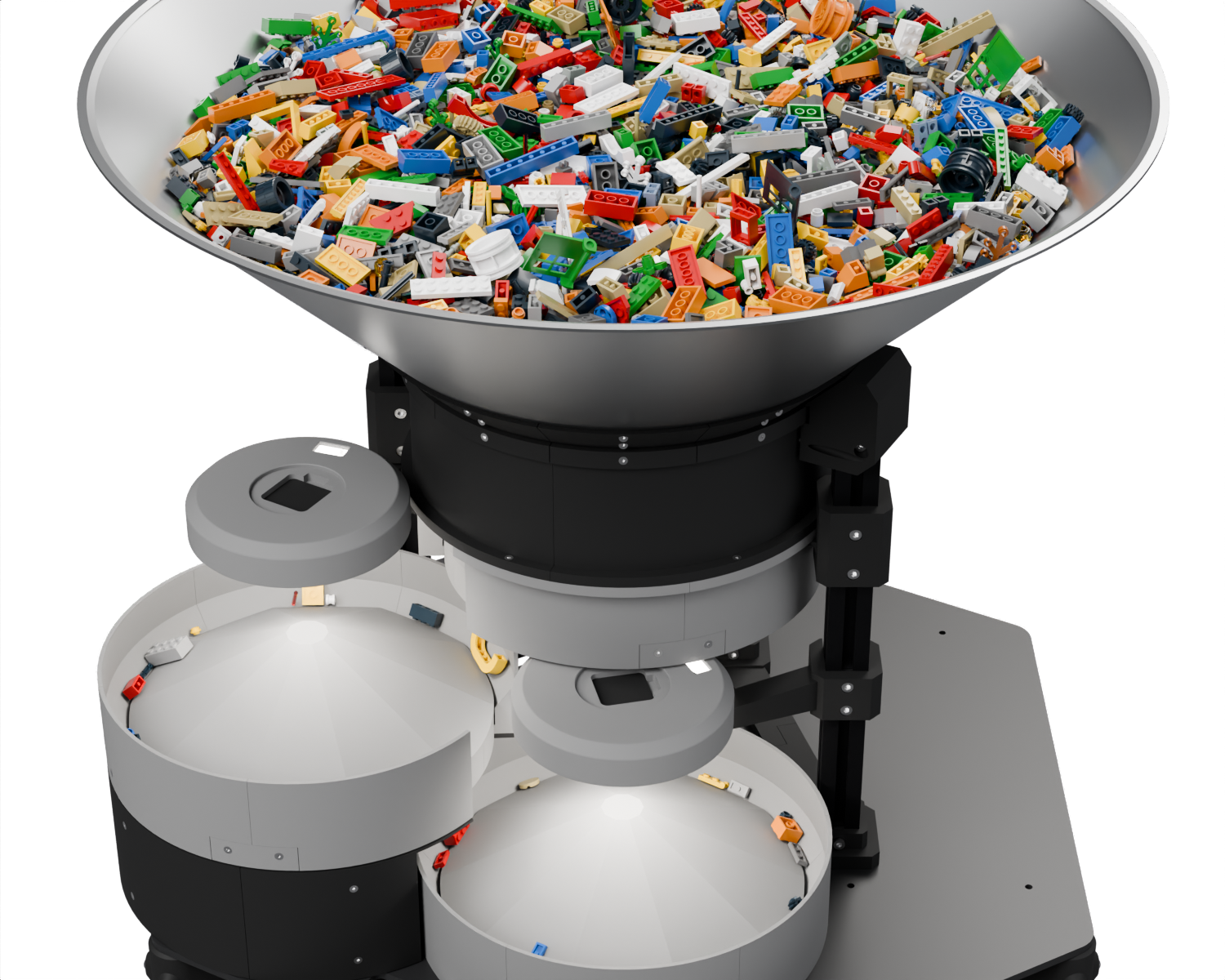
Feeder
One at a time
The feeder turns a pile into a line of single pieces.
The mark
The mark is a hollow brick, two studs, drawn in isometric line. It is made of two things and nothing else.
The outline is the black of the original logo: the six outer edges, the three edges that meet at the front corner, each stud’s rim, and the far wall seen down each stud.
The fill is the white of the original logo: the three faces and the two triangles inside each stud. The fill is the brick’s material. What is not fill and not outline is a hole, and the background shows through it.
Two ways to draw it and no third. On a light background, outline with fill: the logo as it is, faces in paper. On a dark background, the fill alone in paper, no outline, the lines left as gaps. Fill only in ink exists for the odd light case. The outline is never drawn alone: hollow lines with a colour showing through the faces is not the mark.
Brand block
The only place cyan appears. Brick above wordmark, outline in ink with the fill in paper, hard corners, and the panel runs to an edge of the page it lives on.
Dark
Paper and ink swap. That is the whole of dark mode. Yellow stays yellow with ink on it, cyan stays cyan with ink on it, and the photo stage stays a white room, because it is one. Lines and buttons follow the swap: paper lines, paper buttons with ink text.
It follows the system preference until the toggle in the nav is used, and then remembers. Every dark rule is a dark: modifier next to its light one; the four custom classes carry theirs the same way.
Light
Sorter
The Brick Sorting Machine
Dark
Sorter
The Brick Sorting Machine
Build
How a page of ours is made, so the design survives the code. The long version is design-system/engineering.md in the repo.
Stack
SvelteKit with the static adapter, Tailwind 4, Sofia Sans from Google Fonts. Tokens live in one @theme block; the markup uses them by name and never a raw hex.
Custom CSS
A short list: the rule, the highlight, the stage, the label, the figure, the word behind an object. Everything else is a utility on the element. A new class is a discussion.
Dark
A dark: modifier beside every light one, on the element. No second stylesheet, no theme object, no colour that only exists in one mode.
Lines
One pixel, ink, and never two together. A section owns its top rule, a row its bottom, a card its border and its internal dividers. Check the seams every time two of them meet.
Every page has a card
A page is registered with its title, description and image before it exists. The head is written from that, and so is its social card, rendered from the page's own components at 2400 × 1260. An unregistered page fails the build.
Images
Never in git. They live in the asset service and the page references them; a script pulls them into place. Renders are trimmed to the object so a layout can trust the image's edges.
The object
Text behind an object is sized from the figure, not the viewport, so the overlap is the same everywhere. Video shot on white is multiplied onto the stage.
Check it
After any change: both modes, the seams between lines, the three widths that break layouts, the card for every page. Then look once more at the mark.
Voice
Say what it does. Say what it is made of. Say what it costs. Then stop.
Do
- I don’t like sorting.
- Bulk pieces come in through the top.
- The first sorting machine that is reproducible and mass-manufacturable.
- Sixty bins. One rule per bin.
Don’t
- Revolutionize your workflow with AI-powered sorting!
- THE ULTIMATE BRICK SOLUTION
- Unleash the power of automation.
- Any exclamation mark.
Sorter
Automatic LEGO® Sorting Machine
Design system rev01, 2026-09-13. Built from Cindy’s May 2026 banner, poster and card, the Blender renders of the Sorter, and the notes in the vault’s design-system project. LEGO® is a trademark of the LEGO Group, which does not sponsor or endorse this.